
Jangarh Singh Shyam
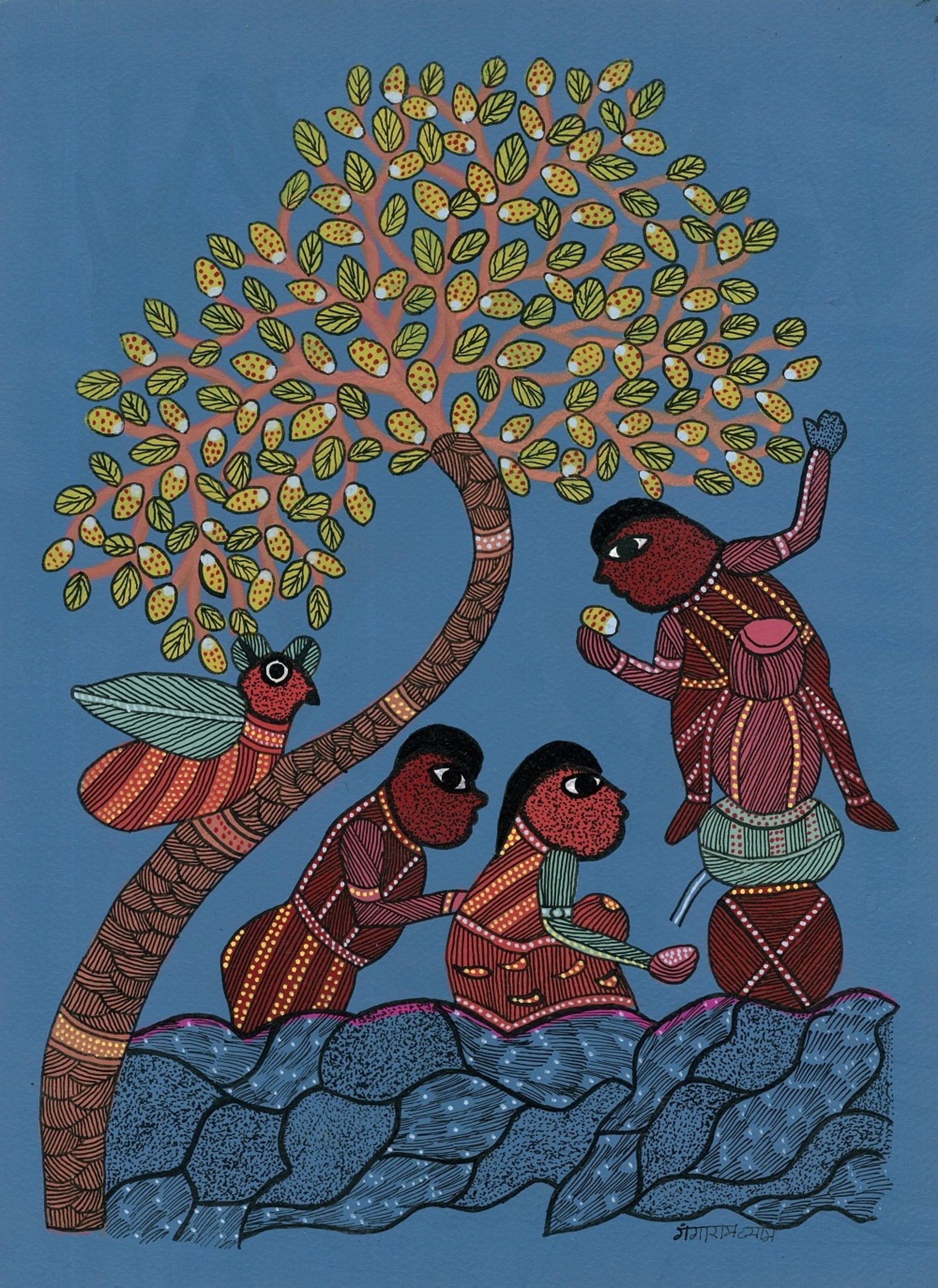
Madhya Pradesh's Pardhan Gond trailblazer birthed Jangarh Kalam, electrifying traditional Gond visions with vivid colors, intricate dots, and dynamic patterns that conquered the world stage.
ART WORK

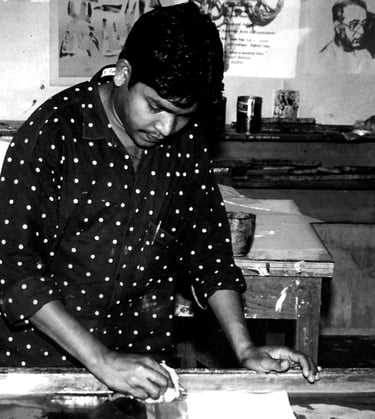
Jangarh Singh Shyam (1962–2001) was a visionary Pardhan Gond Adivasi artist from Patangarh, Mandla (Madhya Pradesh), who rose from a life of poverty and minimal formal education to become a pathbreaking figure in contemporary Indian art. Discovered in 1981 by artist J. Swaminathan for his striking village murals, he moved to Bharat Bhavan in Bhopal, where he began working with paper, canvas, acrylics and ink, shifting Gond painting from ritual wall art into a gallery-ready, contemporary form.
Over the 1980s and 1990s he developed the now-famous Jangarh Kalam style, marked by dense dots and lines, luminous reds, blues, greens and yellows, and vibrating textures that animate deities, spirits, animals, trees and mythic landscapes drawn from Gond cosmology. His works were shown in landmark exhibitions like “Magiciens de la Terre” (Paris, 1989) and “Other Masters” (New Delhi, 1998), and he created major murals for Bharat Bhavan and the Madhya Pradesh Vidhan Bhavan designed by Charles Correa, firmly establishing him as a leading contemporary Indian artist rather than just a “tribal painter.”
Honoured with the Shikhar Samman in 1986, his paintings later entered international collections and auctions; his 1988 work “Landscape with Spider” achieved a record price for an Adivasi artist at Sotheby’s New York in 2010. As a generous mentor, he inspired an entire Gond–Pardhan school of artists who continue the legacy of Jangarh Kalam, even though his own life ended tragically in 2001 during a residency at the Mithila Museum in Niigata, Japan, at the age of just thirty-nine.